
The History of Bernard Mizeki College
A tribute to the school that shaped generations of Old Mizekians.
A Name Rooted in Sacrifice
Every Old Mizekian carries a name with a story behind it. Bernard Mizeki was a Mozambican-born catechist and missionary. In the 1890s he worked among the Nhowe people of the Marondera district, teaching, healing, and building a Christian community with quiet devotion. On 18 June 1896, he was killed near the hill where he had made his home. He became one of the best-known Christian martyrs of southern Africa. Decades later, a school would rise close to the very ground where he lived and died. It carried his name, and, its founders hoped, something of his spirit of service.
Founding a College for a New Generation
The idea for the College took shape in the late 1950s. Leading figures in the Anglican Church in colonial Southern Rhodesia recognised a pressing gap: there was no institution offering African boys an education of the same quality available at schools like Peterhouse, Ruzawi, and Springvale. Bishop Cecil Alderson and Canon Robert Grinham were central to this push. Together they raised the initial funds that formed the Bernard Mizeki Schools Trust. A deed of trust was drawn up in 1958 and formally registered in Harare on 29 May 1959. This established the legal foundation for the College, built on land next to the old St Bernard's Mission, itself a small school for African boys that had operated on the site since the turn of the century.
The founders, both African and European, men and women, set an ambitious goal: to build a school equal in quality to the finest in the country. At the request of Sir Humphrey Gibbs, they modelled it on Eton College and the private schools of the region. The architect John Vigour drew up the plans in 1959, and construction began in 1960 under Bruce Berrington, working with some of the same artisans who had built Peterhouse. The College was first conceived with hopes of a multiracial, even international, student body. In practice, it went on to serve overwhelmingly African boys, some from as far as the DR Congo, Kenya, Namibia, Tanzania, and South Africa, simply because the demand for quality secondary education among them so vastly outstripped the places available.
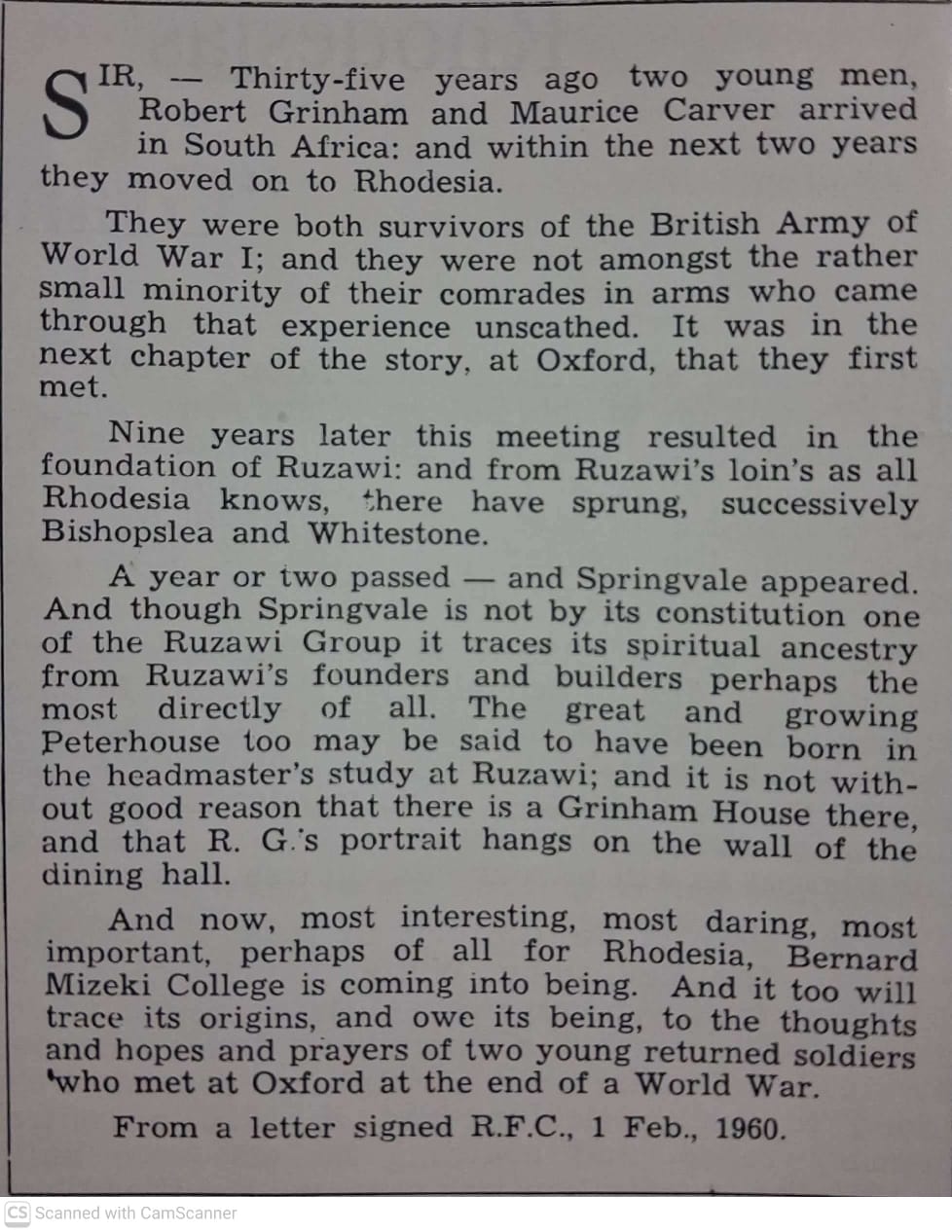
Source: Rotary International, Marondera Golden Jubilee, 1913–1963.
The College's motto, Liberavi Animum Meum, means "I have freed my soul." It captured the founders' vision: an education not narrowly built around examinations or vocational training, but one meant to build character and leadership for the future.
Building the Foundations: The First Governing Boards
The Bernard Mizeki Schools Trust set out its founding purpose in August 1958: to educate pupils in a liberal manner, not narrowly bound to vocational or examination requirements, with the aim of building character and leadership. For the smooth running of the new College and its efficient administration, a structure of boards was set up in 1959, each answering to the one above it: Patrons who advised the Trustees and Governors, a Board of Trustees who raised the College's founding capital, and a Board of Governors who, through an Executive Committee and the Headmaster, oversaw the day-to-day running of the school. An Action Committee later took on the construction and expansion of the College and its primary school.
Patrons · appointed 1959
Advised the Board of Trustees and Governors.
- The Rt. Hon. Earl of Dalhousie, Governor-General of the Federation of Rhodesia and Nyasaland
- Sir Humphrey Gibbs
- Lord Ellis Robins
The Board of Trustees · 1959
Custodians of the College, responsible for raising the initial capital for its construction.
- Sir Robert Hudson
- Sir Stephen Courtland
- Mr. Grafftey-Smith
The Board of Governors · 1959
Entrusted with the management of the Trust's business, overseeing the College through the Executive Committee and the Headmaster.
- The Bishop of Mashonaland, Rt Rev Cecil W. Alderson
- Canon Robert Grinham
- Archdeacon Wood
- Adv. Herbert W. Chtepo
- Sir Robert Tredgold
- Sir W. C. R. Honey
- Sir K. Acutt
- Mr. Robert E. Brown
- Sir Lascelles
- Sir Lycett
- Prof. S. H. Harper
The Executive Committee · 1959
Appointed the Headmaster and ran the College's business on the Board of Governors' behalf.
- The Bishop of Mashonaland, Rt Rev Cecil W. Alderson
- Canon Robert Grinham
- Miss B. Tredgold
- Miss Fisher
- Mr. F. R. Snell
- M. Hammond
- Mr. Carver
- Fr. Zambezi
- Mr. Sagonda
- Mr. Paterson
- Sir Currey
The Action Committee · formed 1961
Spearheaded the College's construction and expansion, and oversaw both the College and the primary school.
- Mr. G. R. A. Johnson (Chairman)
- Mr. G. C. V. Coppen
- Canon R. Grinham (Secretary)
- Mr. F. R. Snell (Founding Rector of Peterhouse)
- D. T. Collumbell
The Doors Open
Bernard Mizeki College welcomed its first pupils in January 1961, under its first headmaster, Peter Holmes Canham, a civil servant who arrived from British West Africa. By October 1962, the young College had already earned a seat at the table of the country's leading independent schools. It became a founding member of the Association of Trust Schools (ATS), the same gathering that gave rise to the Conference of Heads of Independent Schools in Zimbabwe (CHISZ).
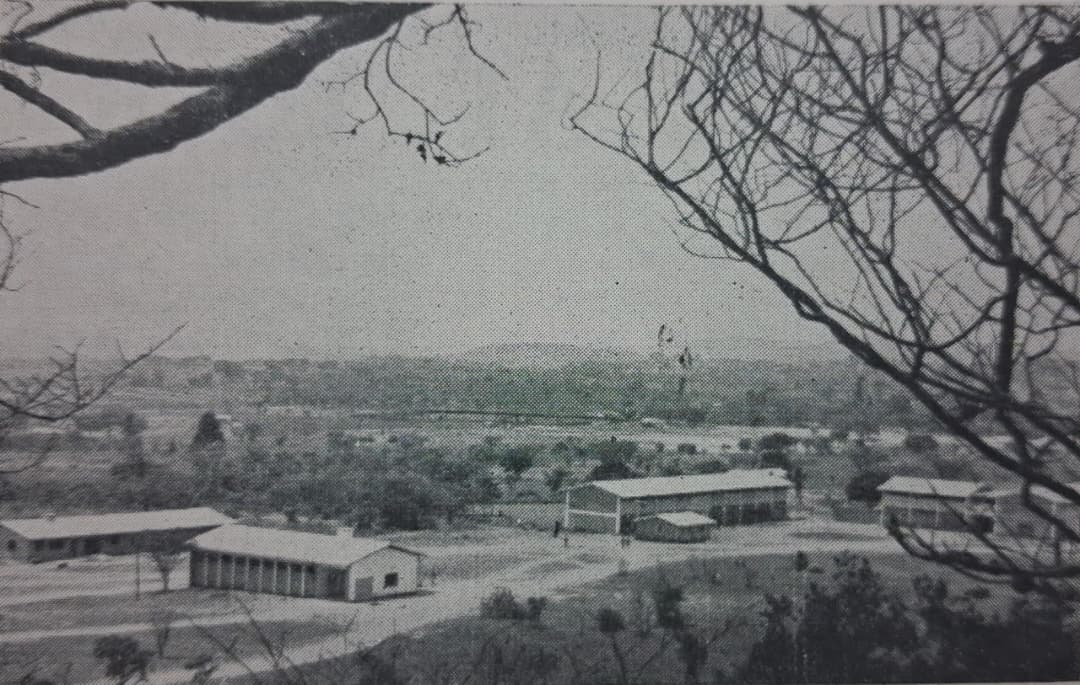
Source: Rotary International, Marondera Golden Jubilee, 1913–1963.
In these early decades, the College's boys competed in sports rarely open to African students elsewhere: cricket, rugby, hockey, tennis, and golf. It was a hard-won privilege that came with its own frustrations, since fixtures against other schools were few and far between. Boys were, and still are, organised into hostels that double as houses. One of these, Kamungu House, is named for the Anglican priest Leonard Mattiya Kamungu.
Years of Challenge and Renewal
Like many trust schools, Bernard Mizeki College weathered difficult periods. In 2015, government austerity measures withdrew salary support for teachers at private and trust schools nationwide. This forced the College, like its peers, into difficult conversations with parents about how to sustain its staff. There were also years when academic results slipped and the College's standing among Zimbabwe's top schools dipped. This prompted concern among parents and alumni alike, and for four decades its membership in ATS and CHISZ lapsed.
But the College's story has always been one of renewal. Under the leadership of Headmaster Howard Mathews, a sustained programme of reform lifted standards once again, and that renewal has been carried forward by its alumni as much as by the school itself.
The Old Mizekian Family
No history of the College is complete without its alumni. The bond between Old Mizekians and their school has always run deep, and in recent years that bond has found new expression. The 2023 Old Boys Weekend brought former students back to campus for friendly sporting fixtures, including a football clash against Old Boys of Kutama College. The Old Mizekian Association also does ongoing work connecting generations of alumni through this very website, sharing event announcements, project updates, networking opportunities, and fundraising for the school that shaped them.
From a small mission school on a farm near Marondera, to a College modelled on Eton, to a proud member of the world's leading coalition of boys' schools: Bernard Mizeki College's history is really a story about people. It is about the martyr whose name it bears, the founders who dreamed it into being, the teachers who built it up, and the generations of boys who walked through its gates and carried Liberavi Animum Meum out into the world.
Leadership Through the Years
The exact years covering 2000–2007 are still being confirmed with the College and History Committee.
| Years | Headmaster |
|---|---|
| 1961–64 | P. H. Canham (founding Headmaster) |
| 1965 | R. Glazebrook |
| 1966–70 | J. Davidson |
| 1971 | Fr. Andrew Hunt |
| 1975 | Fr. L. Davis |
| 1978–80 | Chiyadzwa |
| 1981–89 | Chikodzore |
| 1990 | O.M. Ndowora |
| 1991–2000 | Francis J. Matambanadzo |
| 2000– | To be confirmed |
| 2007–10 | M. Mbuwayesango |
| 2011–20 | P. Nhewyembwa |
| 2021–date | H. A. Mathews |
Peter Canham, the College's first headmaster, was a firm believer in entrenching leadership skills in students. As soon as the first pupils arrived, he arranged the first elections to democratically choose a Head of School from among them. In those early years, the prefects' body was known as the Senate, and the Head of School held the title of President. At every opportunity, Canham let the student body make its own decisions and take up leadership roles within the school community.
| Years | School Captain |
|---|---|
| 1961–62 | L. Manata |
| 1963–64 | J. Kawonza |
| 1965 | P. Mwamuka |
| 1966 | M. Mabhena |
| 1967 | A. Mwedzi |
| 1968 | P. Moyo |
| 1969 | M. Gozo |
| 1970 | A. Nyazika |
| 1971 | D. Chitambo |
| 1972 | C. Mungwari |
| 1973 | T. Mushove |
| 1974 | L. Mudzingwa |
| 1975 | C. Magaya |
| 1976 | S. Mudangepfupfu |
| 1977 | E. Tlou |
| 1978 | S. Tendaupenyu* |
| 1979 | T. Kashangura |
| 1980 | C. Kachambwa |
| 1981 | W. Mushowe |
| 1982 | J. Patsika |
| 1983 | P. Makoni |
| 1984 | J. Maruta |
| 1985 | N. Sam |
| 1986 | A. Chikoore |
| 1987 | D. Mapenzauswa |
| 1988 | C. Chari |
| 1989 | M. Mazungaire |
| 1990 | E. Nyanga |
| 1991 | A. Mushaninga |
| 1992 | E. Chakaodza |
| 1993 | E. Watyoka |
| 1994 | W. Hwata |
| 1995 | T. Mandengu |
| 1996 | A. Makamba |
| 1997 | E. Bunhu |
| 1998 | I. Tendaupenyu* |
| 1999 | R. Neruwana |
| 2000 | J. Gwaze |
| 2001 | T. Chekera |
| 2002 | A. Shito |
| 2003 | T. Pfupa |
| 2004 | M. Katuri |
| 2005 | E. Donzvambeva |
| 2006 | T. Muchetu |
| 2007 | L. Jura |
| 2008 | K. Shereni |
| 2009 | M. Mupotsa |
| 2010 | S. Mubvuma |
| 2011 | T. Matarise |
| 2012 | R. Manata |
| 2013 | T. Chigumbu |
| 2014 | A. Mwanza |
| 2015 | |
| 2016 | |
| 2017 | |
| 2018 | |
| 2019 | |
| 2020 | |
| 2021 | |
| 2022 | |
| 2023 | |
| 2024 | |
| 2025 | |
| 2026 |
Father and son legacies. Twice, a Mizekian torch has passed from father to son in this office: L. Manata (1961–62) and R. Manata (2012), and S. Tendaupenyu (1978) and I. Tendaupenyu (1998).
Records are being compiled hostel by hostel; blank cells are still being confirmed with the College and History Committee.
| Year | Kamungu | Molele | Masemola | Kapuya |
|---|---|---|---|---|
| 1961 | ||||
| 1962 | ||||
| 1963 | ||||
| 1964 | ||||
| 1965 | ||||
| 1966 | ||||
| 1967 | ||||
| 1968 | ||||
| 1969 | ||||
| 1970 | ||||
| 1971 | ||||
| 1972 | ||||
| 1973 | ||||
| 1974 | ||||
| 1975 | ||||
| 1976 | ||||
| 1977 | ||||
| 1978 | ||||
| 1979 | ||||
| 1980 | ||||
| 1981 | ||||
| 1982 | ||||
| 1983 | ||||
| 1984 | ||||
| 1985 | ||||
| 1986 | ||||
| 1987 | ||||
| 1988 | ||||
| 1989 | ||||
| 1990 | ||||
| 1991 | ||||
| 1992 | ||||
| 1993 | ||||
| 1994 | ||||
| 1995 | ||||
| 1996 | C. Silumba | E.T. Muchibwa | L. Machanzi | T. Kadandara |
| 1997 | S. Mapfumo | C. Adano | C. Musarurwa | P. Nyadembera |
| 1998 | T. Nyajeka | K. Madzimbamuto | ||
| 1999 | F. Mahwite | T. Mavetera | ||
| 2000 | ||||
| 2001 | ||||
| 2002 | ||||
| 2003 | ||||
| 2004 | ||||
| 2005 | ||||
| 2006 | ||||
| 2007 | ||||
| 2008 | ||||
| 2009 | ||||
| 2010 | ||||
| 2011 | ||||
| 2012 | ||||
| 2013 | ||||
| 2014 | ||||
| 2015 | ||||
| 2016 | ||||
| 2017 | ||||
| 2018 | ||||
| 2019 | ||||
| 2020 | ||||
| 2021 | ||||
| 2022 | ||||
| 2023 | ||||
| 2024 | ||||
| 2025 | ||||
| 2026 |
Content coming soon.
Content coming soon.